
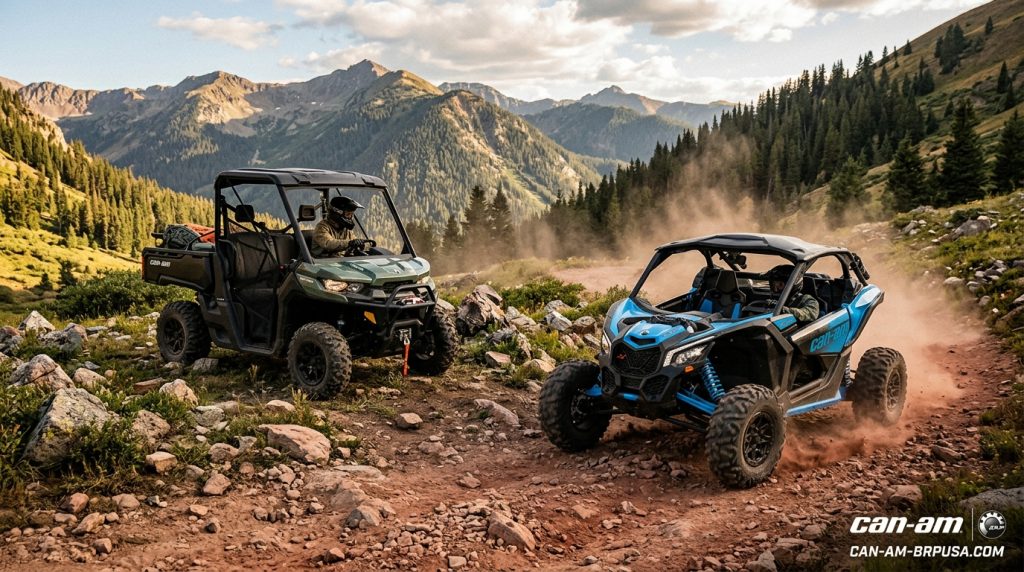
Selecting the right side-by-side (SxS) vehicle requires a clear understanding of your primary driving demands. Whether you manage expansive agricultural acres, need a heavy-duty workhorse around job sites, or crave adrenaline-pumping speed across sand dunes, modern utility task vehicles (UTVs) are engineered with hyper-specific engineering priorities. Among industry leaders, BRP’s Can-Am lineup continues to define power, torque, and chassis dynamics across both utility and sport categories.
Utility Engineering: Power and Payload for Demanding Work
When your vehicle functions primarily as an essential tool, raw horsepower takes a backseat to usable torque, cargo bed capacity, and towing ratings. Utility-focused side-by-side platforms are purpose-built to replace traditional compact tractors or pickup trucks across tight ranch quarters and rough terrain.
1. High-Torque Rotax Engines
Unlike high-revving sport engines, work-oriented UTVs utilize low-RPM engine tuning to maximize pulling force from a full stop. This low-end torque allows smooth power delivery when hauling heavy cargo beds or pulling heavy trailers across mud and steep inclines.
2. Cabin Comfort and Cargo Versatility
Modern operators spend entire workdays inside these cabs. Modern utility vehicles incorporate dynamic power steering, climate-controlled enclosed cabs, and intuitive storage configurations. Models like the versatile Can-Am Defender set the standard with class-leading towing capabilities up to 2,500 lbs and adaptable cargo box layouts.
3. Heavy-Duty Chassis Design
A rigid steel chassis paired with arched double A-arm suspension ensures maximum ground clearance even under full load capacity. Integrated skid plates protect vital drivetrain components against rocks, stumps, and debris encountered on unmaintained property trails.
Sport Performance: High-Speed Dynamics and Suspension Engineering
For riders driven by off-road sport, dune carving, and technical rock crawling, side-by-side selection shifts toward power-to-weight ratios, long-travel suspension, and high-speed stability.
Key Difference: Utility UTVs prioritize low-end towing torque and cargo payload, whereas Sport UTVs prioritize horsepower, suspension travel, and high-speed stability across violent terrain.
Advanced Suspension Geometry
Sport UTVs use complex multi-link semi-trailing arm suspensions with FOX or SHOWA bypass shocks. This configuration provides up to 25+ inches of usable suspension travel, swallowing deep bumps and severe landings without transferring harsh forces to the driver.
Turbocharged Horsepower
In the pure sport segment, high-output turbocharged engines dominate the market. Drivers looking for extreme responsiveness and speed frequently rely on the industry-benchmark performance of the Can-Am Maveric, engineered with aggressive power delivery and intelligent throttle control for technical terrain.
Comparing Utility vs. Sport Side-by-Side Features
To help you decide which setup aligns best with your land or recreational needs, consider how core specs match up across vehicle classes:
| Feature Category | Work & Utility UTVs | Pure Sport UTVs | Hybrid / Cross-Utility UTVs |
| Primary Goal | Towing, hauling, property maintenance | Dune riding, trail speed, rock crawling | Hunting, light work, recreational trails |
| Engine Tuning | Low-RPM torque focus | High-RPM turbocharged horsepower | Balanced mid-range torque & speed |
| Towing Capacity | 2,500+ lbs | 0 – 1,000 lbs (Minimal focus) | 1,500 – 2,000 lbs |
| Suspension Travel | 10 – 12 inches | 20 – 30+ inches | 14 – 18 inches |
| Seating Ergonomics | Upright bench or captain seats | Low-slung bucket seats with harnesses | Ergonomic adjustable bucket seats |
Essential Maintenance Practices for Peak UTV Reliability
Regardless of whether your side-by-side spends its life on the farm or high-speed desert trails, keeping up with routine service safeguards your investment:
- CVT Drive Belt Inspections: Check your Continuously Variable Transmission (CVT) belt regularly for excessive wear or heat glazing. Heavy towing in high gear or deep mud slipping can degrade belts prematurely.
- Air Filter Servicing: Off-road environments generate thick dust clouds. Clean or replace your engine air filter after every major dusty ride to keep abrasive grit out of your engine cylinders.
- Differential and Gearbox Oils: Change front differential and rear transmission fluids according to manufacturer service intervals, especially after driving through high-water crossings.
- Grease and Suspension Pivots: Frequently grease all suspension A-arm bushings, sway bar links, and drive shaft u-joints to prevent rust and maintain smooth suspension movement.
Summary
Choosing between a utility-focused or high-performance sport UTV ultimately comes down to how you plan to use your machine. By matching your daily operational needs with the right chassis, suspension, and drivetrain configuration, you ensure maximum productivity, long-term vehicle durability, and an unmatched off-road experience.
